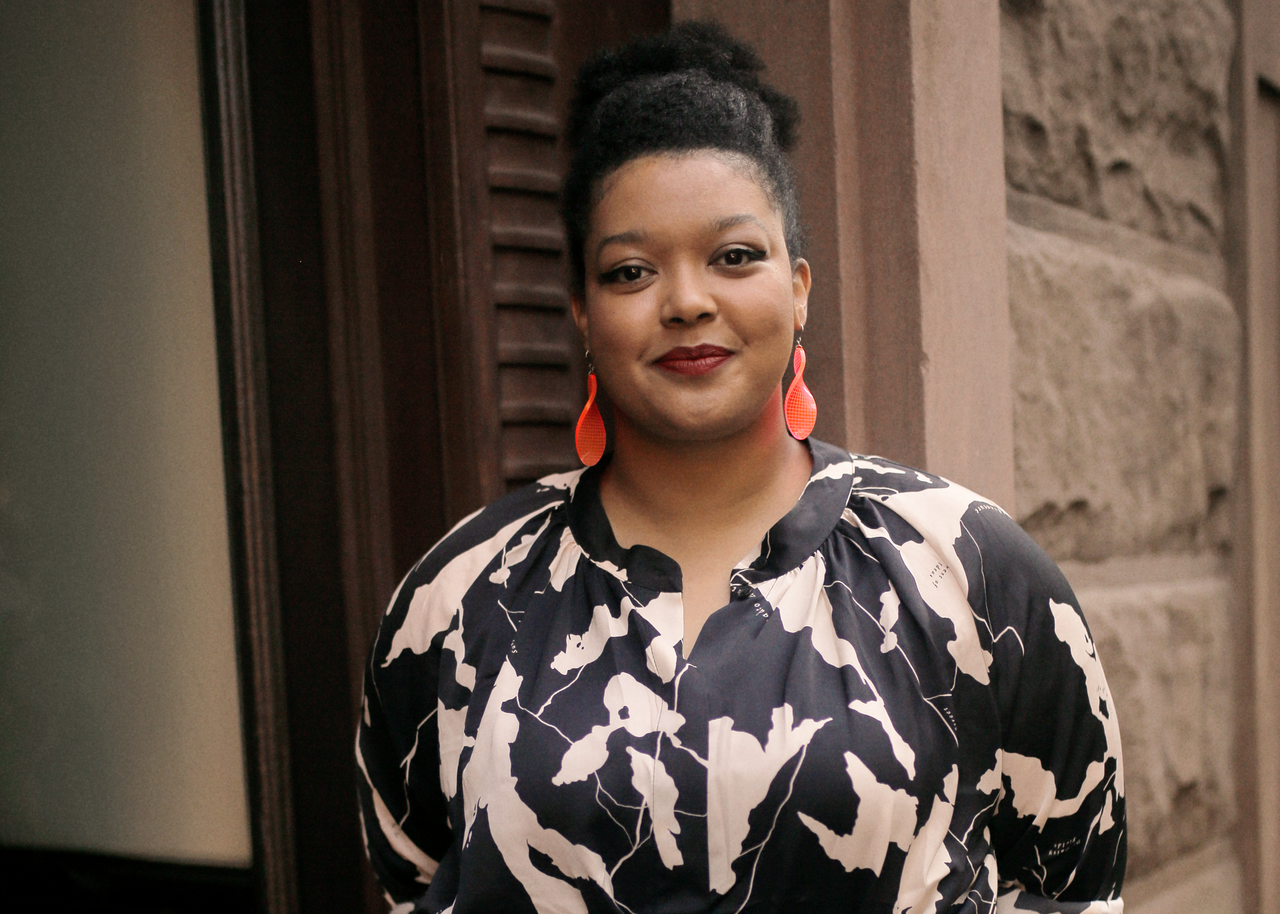
Black Women Techmakers: Ashley Jane Lewis

As a part of Women Techmakers storytelling campaign highlighting Black women in tech, we’re sitting down with 6 Black women in the industry to learn more about their work. Each woman is engaged in incredible work that is shaping the future of tech through art, innovation, engineering and a commitment to social impact. All of the conversations focus on the theme of intuition and intentionality, through the lens of their individual experiences.
Ashley Jane Lewis is an afro-futurist / nowist, hobby scientist and educator. Her new media art has graced some of the world’s most prominent spaces from Maker Faire to the White House. Ashley’s art explores the connection of the Black identity in the past, present and future. The setting of her interview takes place on the sidewalks of bustling New York where she resides and works when she is not also living and thriving in Canada. Read her interview with TONL Co Founder, Karen Okonkwo as they talk about her Black identity growing up in Canada, how she found her niche at the intersection of art and technology and what’s next for her.
Karen: When it comes to you growing up predominantly in Canada, how was that experience for you as a young, Black girl? What does it mean to be Black in Canada?
Ashley Jane: It's all that was ever normal growing up. My parents are immigrants, one from Jamaica, one from England, both Black identifying. So, the ecosystem of Canada (I can only really speak to the place where I grew up, which is in Toronto and in Ontario) is super diverse. It's very different from America, broadly. The relationship to diversity is a conflict. I’m having trouble answering this question because I think about this all the time and my opinion changes on it all the time. The Toronto location specifically is the world's largest location for people immigrating from the West Indies so there's a lot of Jamaican people there. There's a lot of people who do not overtly look like me, but share some kind of culture. So, that is really welcomed in the city of Toronto, as well as other huge demographics of people so the relationship of being Black in one of those spaces is different than the U.S. because though Canada certainly had a relationship to slavery, there are many, many ways that people ended up in Toronto and Ontario. So I feel like the interesting thing about my experience being Black in America so far is that there's so much broad discourse around the history of Blackness, around the oppression of Blackness.
When you don't have one predominant narrative as to how people arrived in your city or country, sometimes it makes it more challenging to have big ubiquitous conversations about race. So that's an interesting kind of challenge about Canada. Realistically, I think that there's race issues in both cities [Toronto and Ontario]. Canada has always tried in their PR to talk about how much they embrace and welcome diverse identities because most people (if you're not first nations) are coming from somewhere else. There’s an enormous amount of people coming from Ireland and the UK and Asia and India. However, because Canada really is known as this peacekeeper who wants to be seen as this beacon for people who are from elsewhere, sometimes your lived experience of racism gets denied. So it's challenging to be a Black person in Canada at times because you are like, “Hey, bad things happen here!” Like, police brutality, like racism. A lot of folks are really unaccustomed to having that conversation because we have so much public relations and so much media around Canada being this great place for diversity. So it can be a bit challenging, whereas here in the U.S., it feels so known with race related issues, you know?
Karen; Yeah, yeah. I like your perspective because I think that sometimes people like to give a curated answer of what people want to hear and I'm more so looking to see what is your unique experience so I appreciate you sharing that.
So in you growing up in that society where there was this push for promoting this diversity, how do you feel the climate that you grew up in shaped your personal and professional career?
Ashley Jane: So I guess I should just really be clear that my criticism of it [Canada] is that it's mostly just in the media all alone. It's been like “look at us, we’re diverse”, but I don't think the resources are actually there to make that support possible. I think that's one overarching challenge.
I didn't grow up in a super diverse neighborhood and because of that you spend a lot of time thinking about your Black identity. You spend a lot of time trying to figure out how your relationship to your work should exist. As a person who pursued technology and sciences and art, but through the conduit of technology and science, you just don’t….I did not grow up meeting and knowing people like me who were doing those things at all.
So that was really challenging because at all turns you're sort of like consciously thinking about whether this is a safe space. Am I entering into a safe career? One thing that I will credit a lot of my upbringing for in education is that I did know a lot of women who were doing those things. So there was a little bit of me that was riding off of that emotional connection to say,” okay, so I know it's not an abundance of women in science, not an abundance of women in technology, but certainly some”. Then, I think I was just searching all the time for the Black equivalents of that and I really found that stuff so late, like very, very late into my experience in this industry.


Karen: Yeah. Representation absolutely matters and it really can help accelerate you and propel you in a direction that obviously can be fruitful, but a lot of people, they just don't have that access.
So for you, what was the biggest push for you to want to get into the tech and science world and the intersection of art and race? What was that defining moment for you that you're like, “I'm sitting where I need to be”?
Ashley Jane: In high school, I really loved art. I did not like science at all or mathematics, which is usually how people get into technology. Those things were not really afforded to me as viable places to find support from professors. So I did really well in lots of art and English classes and things like that. I think because the conventional frame of thought is there are Black artists, so sure, she could do well here, I think that I had a lot of support there. But, in sciences and mathematics it was traumatizing, awful, so bad. So when I was applying to undergrad, I was thinking about what I wanted to do. I knew I wanted to pursue art. I was trying to figure out how I could pursue art without having to define exactly which kind of art I wanted to make. I loved dancing. I loved sculpture. I loved installation. It was just too much for me to say, “I’m going to go to school to be an illustrator.” “I’m going to go to school to be a sculptor”. So I found this program at a school in Toronto and it was like an art program, a BFA, but it was also scoped as an abundance of opportunities to integrate the kinds of art you want into your practice and it was called ‘new media’. I looked at a lot of the documentation and there was a lot of technological installation art. What I really was excited about was seeing art in museums and galleries and I was like, cool; I think I want to do that. But I had no idea at all that it would require me to know how to use or be proficient in technology. So I applied to this program with painting, sculpture and writing and they accepted me.
Then on day one, they were like, “Okay, so welcome to introduction to coding”. I was like, “What?” I was so scared. I remember I made my first friend in that program because I went to the bathroom and cried because I was like, “I don't know how to code. I don't even know what to do!” But, it ended up being so satisfying, which is really ironic because all of my elementary school and high school life, I had really hated math and really hated physics, but through the lens of coding that not only lets you implement art, but also implement experience into your work it was totally different. So instead of learning about physics equations, you could watch a robot scurry across the floor. It's a robot, not because of militarized robotics or the next wave of technology, but it's a robot that's trying to engage an audience in this context of what you would see at an art gallery. So it felt so satisfying.
I started to really fall in love with all of the things that I had hated for so long. Like learning about new, geometric forms through 3d printing, learning about speed, slope and algorithms through coding and really spending a lot of time building reactive and interactive structures. All of these skills I had to learn a little catch-up for because
I was never really folded into that in high school. So my undergrad had a lot of women and a lot of queer women and that representation was really good, but my undergrad did not have an enormous amount of diversity. As a person who was always really interested in social justice in high school, I did a lot of amnesty work and a lot of clubs that helped create safe spaces for diverse people. It was always really important to me.
Eventually, it just felt like a natural connection to start making work when you're posed in undergrad to make work about things that matter to you. It was right around the time when Barack Obama was elected into office for the very first time and so I made the first race-related piece. And I'm telling you it was just super serendipitous because I had made this keyboard and I had very lovely, but admittedly white male professors and they were like, “Cool; great work”, but never really tried to push me into the public discourse with that kind of piece that was so topical. But, I had one professor who was Black and he was like, “Hey, this is a really important piece and a really important stage in the Black history. You should apply to a couple of different festivals with this”. He forced my hand into applying for Maker Faire, which at the time was really small in Toronto, but really big elsewhere. So that kind of anxiety was really supported by this Black professor. I applied and I toured it at Toronto Maker Festival and then I toured it in Detroit as well. It ended up being featured on the White House website and it became this opportunity to really start to talk about race through the conduit of technology and through the conduit of art. So that's really the timeline of it. I wish the story was, “and then I saw that there was nobody doing this that I knew and I was like, I'm going to make race-related stuff”, but, it wasn't like that. It was more so like, “oh gosh, I care about these things. Will they ever come together?” and then really getting support from somebody to say like they could go together.

Karen: I love that. That keyboard idea I think was genius. I was like, that is incredible. An incredible way to combine everything that you've learned, all the skill sets and see that manifest itself.
I think that there's a lot of intuition in making decisions about art or just how you move. When have you felt like you've pulled onto your intuition to create something that actually developed meaning for you?
Ashley Jane: Yeah, intuition is a huge part of this whole ecosystem in so many different ways. I mean, I really loved seeing that question. I don't get this question a lot and I do get a lot of the same questions often so I was really excited because speaking directly from my perspective, I think I use my intuition all the time as a means for survival. I think that a lot of Black people do. I think you're assessing spaces that you walk into whether they be actual rooms full of people or whether they be blocks down the street or just all of the close calls. I can remember where my physical body was in a position of danger because of my race - specifically because of my race. So I think that the intuition that I have has really saved me in lots of ways to get that little tingling in the back of your mind and say, “you know what? I think I gotta get outta here”. I think that's certainly happened to me in Toronto, all over Canada and one hundred percent in New York that have been some risky moments. I think that that's true of lots of Black people. My grandmother and my mom and my dad talk about this intuition too. Not as like a ‘sit down and listen to this lesson’, but more so telling me stories of how their intuition saved them as well from being in the wrong place at the wrong time. Be it just run-ins with oppressors or just run-ins with police close calls. So it [intuition] doesn't work every time, but I think we'll rely on it as Black people a lot and that shows up in so much of our history too. There's intuition that is really well-described in the sort of anthologies of people moving through the Underground Railroad or people who've been through spaces to try and ensure that they are in neighborhoods that are safe and like the Green Mile and the ‘Black nod’….all of these things are intuition based. I think it comes up because it's so common as an internal check-in to turn on the internal barometer. I think it comes up all the time in my work. Sometimes it's simple in a sense of like, “Hey, this thing is happening now. I feel so moved by it. I should try to make a piece on it.” Like with the Barack Obama keyboard, I made this set of pneumatic air pressure controlled lungs that inflated and deflated to pay homage to all of the individuals that were murdered at the hands of police. In honor of Eric Garner, there was a piece called “I can't breathe” and it was exhibited at Google and a couple of other places. So that kind of intuition thinking about if this is moving me, then maybe it might be something that other people might feel connected to. But I also think that the intuition shows up in other ways, like jobs that I really shouldn't have taken because the workplace was so toxic and so racist. I would know walking in there. I would have that gut feeling and sometimes I would follow it and then later I would hear all kinds of stories that assured me that I had made the right decision and sometimes I would be like, “you know what? This is a good opportunity” and then I would be very quickly brought to the awareness that I should have trusted that intuition.
Sometimes, it's intuition around students in my class too. I teach a lot. I teach at Parsons, OPad, Ryerson and the School For Poetic Computation and I teach technology arts. So the classrooms aren't packed with people of color, but I have been correct in assessing my intuition in order to reach out to Black students and say, “Are you good?
Is everything okay?” Or like, “Hey, you know, if you were struggling, my office door is open -let's talk about it.” It's often in the times where I've been correct about student based intuition, it's often that the other students in the room are making it challenging for that person to exist in that class. So I feel intuition comes up all the time and I think it's really one of the internal measurements that I use the most.

Karen: Awesome. Thank you for sharing that. I love all the different angles that you took with that question because it is a story that leads up to how we move. We know that our ancestors leveraged intuition for all of the different ways that they've opened up pathways for us and so now how do we see that in our current generation or current existence? So thank you for sharing that.
What are you currently working on as far as new media art? Is there anything that is really speaking to you right now that you're excited that you'll be sharing soon?
Ashley Jane: Yeah. Oh my gosh. I'm working on so many things. So one of the pieces that I've been working on that was a part of this larger feature is an Afro futuristic piece called “Assign Tech Lab”. This uses biocultures-specifically slime mold (which is a decomposer kind of like mushroom networks) to talk about othered-people, to talk about immigration, to talk about mutual aid and to really spend some time considering the ways that we center humans to make way for greater, more engaging in conversations around multi-species survival.
That piece is an ongoing project and I work on that with an artist named Ayodamola Tanimowo Okunseinde. It's been a dream to work on this piece and to work with other bio cultures. We always talk about how there are three collaborators in that project: me, Ayo and the slime mold!
I'm also working on another piece by myself. It's a fictitious retelling of the past with mycorrhizal. Mycorrhizal is the root network of the mushroom. It's supposed to be the oldest living creature on the planet and it connects through the root systems like every plant matter that is rooted into the ground. In grad school at NYU, I did a few experiments where I trained some mycelium to consume cotton. So this piece is re-imagining the past where the diasporic Black people who were pulled into all kinds of nooks and crannies all across the globe through the Transatlantic Slave Trade, pick cotton and then use that cotton, feed mycelium and have that be a communication network across the planet. So it's kind of science fiction, but it's also based on some truth. Not only because the Transatlantic Slave Trade existed obviously, but also biological truth to the way that mycelium shares information. So it's a layering of fiction and nonfiction, and there'll be some artifacts of that future, of that past and also some interactive storytelling around it. So that piece is something that I'm working on as well. So, yeah, those are some of the ones that I'm most excited about.
Karen: Cool. Thank you. That is mesmerizing. I can't wait to see that live. I don't know where it will exhibit, but I'm looking forward to seeing it. To learn more about Ashley Jane Lewis, click here for the film put together by Google's brand and global program for women in technology: Women Techmakers!